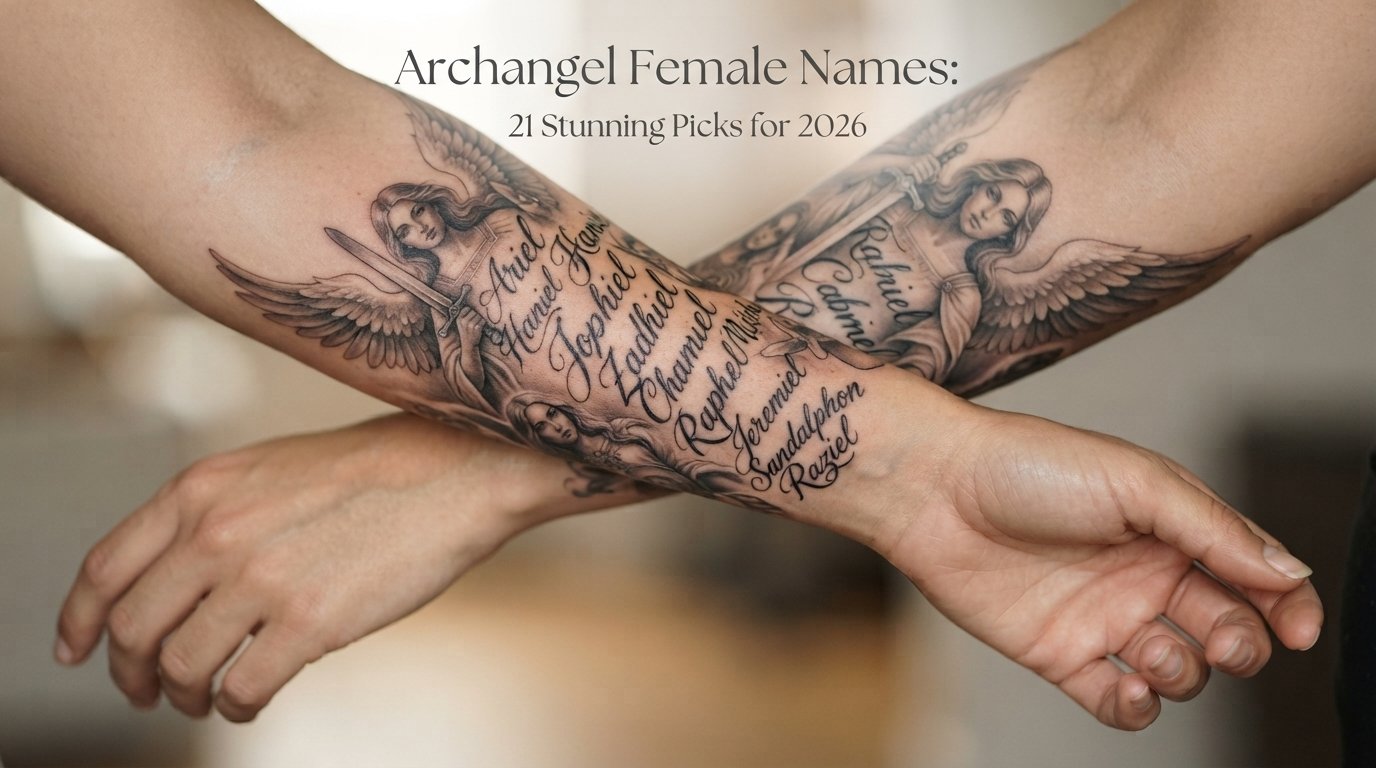
Updated for 2026
Introduction
Here is a number that surprises most people: 56% of American women aged 18 to 29 have at least one tattoo, according to the Pew Research Center (Pew Research Center, 2023). Not 20%. Not a third. More than half. And the single most common reason women give for getting inked is to honor or remember someone or something, at 73% compared with 63% of men (Pew Research Center, 2023).
That is exactly why archangel female names have quietly become one of the most searched categories in meaningful tattoo design. People want a word that carries weight. Something that sounds like protection.
But here is the problem nobody addresses. Search this topic and you get a dozen listicles that confidently label Ariel, Jophiel, and Muriel as “the female archangels,” with zero mention of where any of those names actually came from. Some of those lists include names that are not angels at all. A few include names from grimoire traditions that would horrify the reader if they knew the source.
This guide fixes that. Honestly, this is the part most guides skip.
Key Takeaways
- There are no canonically female archangels in the Bible, Torah, or Quran. Every named archangel appears in masculine grammatical form.
- The feminine archangel names people actually use come from four distinct source traditions, and knowing which tier a name sits in changes whether it is meaningful or just decorative.
- Jophiel, meaning “beauty of God,” is the strongest pick if you want a name with both feminine depiction and a real textual footprint.
- Seven of the 21 names on most “female archangel” lists are not angels at all. They are feminized versions of male angel names or names derived from the word “angel.”
- Script tattoos are the single most regretted tattoo category at 19% of all regretted pieces (Advanced Dermatology, 2023), which makes name selection genuinely high stakes.
- Use the Provenance Ladder and the S.I.G.N. Method below to pressure-test a name before you book.
Start with the table of contents below, or jump straight to the full list if you already know what you are looking for.
Table of Contents
- What Archangel Female Names Actually Are
- Female Archangels List: 21 Names and Meanings
- Archangel Female Names Comparison Table
- Women Archangel Names Tattoo: Style and Placement
- Guardian Archangel Names List by Intention
- How to Choose Your Name: The S.I.G.N. Method
- What These Lists Get Wrong
- FAQ
What Archangel Female Names Actually Are
Quick Answer: Archangel female names are angelic names that later mystical, apocryphal, and devotional traditions portray with feminine qualities, even though no archangel is described as female in canonical scripture. The most commonly used are Jophiel, Ariel, Haniel, Chamuel, and Muriel. Their meanings center on beauty, grace, mercy, and illumination.
Archangel female names refers to the set of angelic names that carry feminine associations in art, mysticism, and modern spiritual practice, regardless of whether the underlying text assigns them a gender. That distinction matters more than you would think, and it is the thing almost every competing article glosses over.
Are there really female archangels?
No. Not in the canon.
Every archangel named in the Hebrew Bible, the New Testament, or the Quran appears in masculine grammatical form. Michael, Gabriel, Raphael, and Uriel are all “he.” The closest scripture comes to a winged female figure is Zechariah 5:9, where the prophet sees two women with wings like a stork lifting a basket between earth and heaven. Scholars generally read that passage as symbolic prophetic imagery rather than a description of actual angels, partly because the stork was classified as an unclean bird under Levitical law and partly because the text never uses the word “angel” for them at all.
Islamic teaching is even more direct. The Quran explicitly criticizes the practice of assigning female gender to angels.
So where does the feminine imagery come from? Renaissance and Baroque painters, mostly. Then Victorian devotional art. Then the 20th century New Age movement, which formalized a lot of it.
Where female archangel names actually come from
This is where the Archangel Name Provenance Ladder comes in. It is a four-tier system for grading how well-sourced any angelic name is, and it is the backbone of the list further down.
Tier 1, Canonical. The name appears in the Hebrew Bible, the New Testament, or the Quran. Only three archangels qualify (Michael, Gabriel, and Raphael, with Raphael appearing in the deuterocanonical Book of Tobit). All three are masculine. No exceptions.
Tier 2, Apocryphal and Talmudic. The name appears in texts outside the canon but inside the historical tradition: the Book of Enoch, the Talmud, midrashic literature, the Book of Tobit. Lailah and Ananchel sit here.
Tier 3, Mystical and Kabbalistic. The name appears in the Zohar, in Merkabah literature, in Gnostic texts like the Apocryphon of John, or in medieval grimoires. Jophiel, Barbelo, and Sophia live in this tier. Most of the genuinely feminine-associated names do.
Tier 4, Modern Devotional. The name was popularized in the last 150 years through theosophy, the I AM movement, or contemporary angel literature. Some Tier 4 names are lovely. None of them are ancient, no matter what a Pinterest graphic claims.
A name is not worse because it sits on a lower rung. But you should know which rung you are standing on before you put it on your skin permanently.
Why the gender question matters for your tattoo
Because people ask. Constantly.
If you get “Jophiel” on your forearm and describe her as a female archangel, someone will eventually tell you angels do not have genders. Knowing that the feminine depiction comes from Christian mystical art rather than from Genesis means you can answer that with confidence instead of getting flustered.
Q: Does it matter that these names are not canonically female? A: Only if accuracy matters to you. The feminine associations are real, documented, and centuries old in devotional art. They are just not scriptural. Both things are true at once, and a well-informed answer is more interesting than a confident wrong one.
Female Archangels List: 21 Names and Meanings
Quick Answer: The most widely used archangel female names are Jophiel (beauty of God), Haniel (grace of God), Ariel (lion of God), Chamuel (he who sees God), and Muriel (angel of June). Below, all 21 names are sorted by provenance tier so you can see exactly which tradition each one comes from.
This is the female archangels list organized by the Provenance Ladder rather than alphabetically, because the ordering tells you something the alphabet cannot.
Tier 3: Feminine-presenting archangels in mystical tradition
These are the names with genuine textual roots and genuine feminine depiction. If you want both, start here.
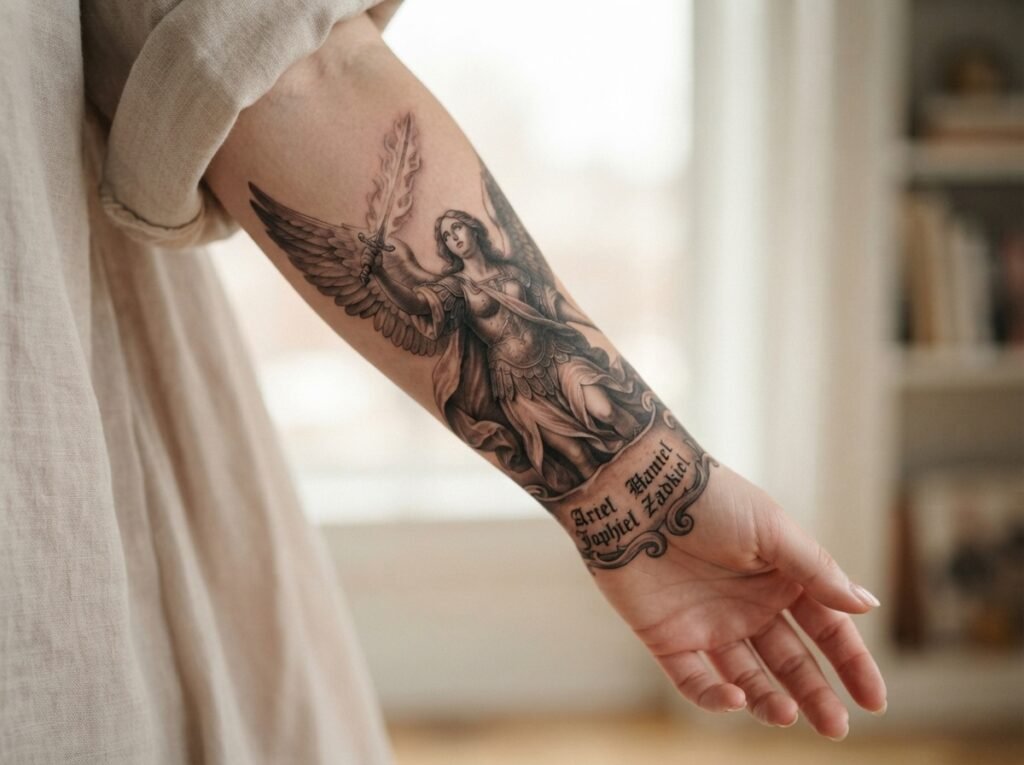
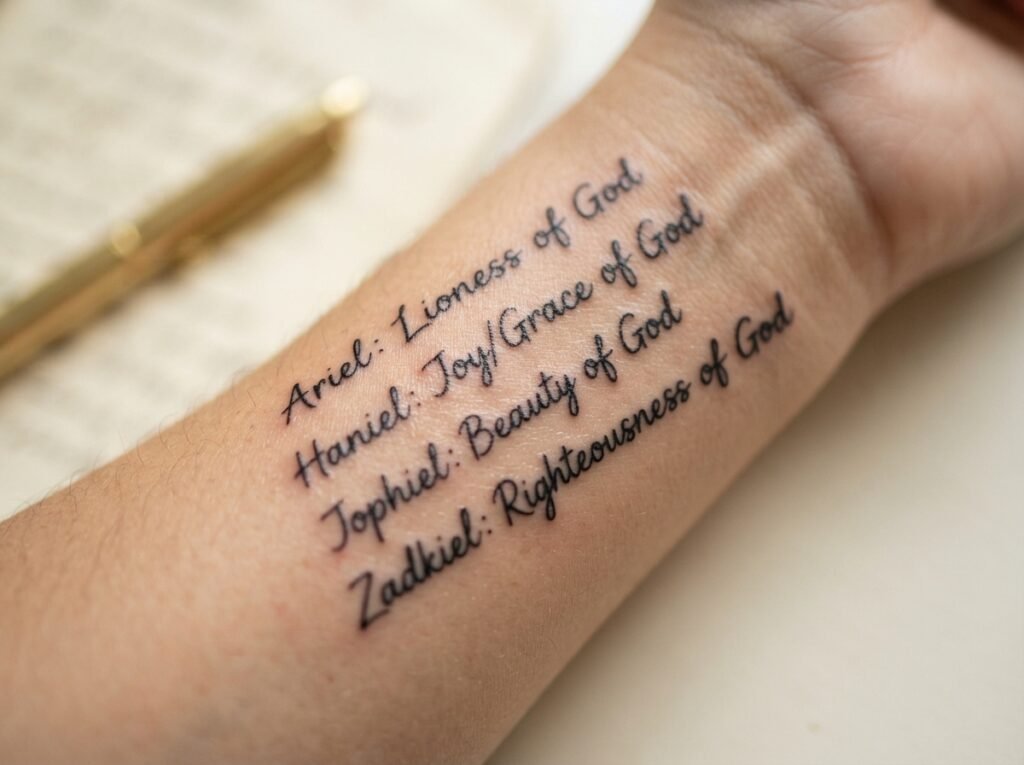
1. Jophiel (also Iophiel, Yofiel, Zophiel) Meaning: “Beauty of God,” from yofi (beauty) and el (God). Jophiel is the angel of beauty, wisdom, and illumination. The Zohar describes Jophiel as a great chief commanding 53 legions. Jophiel is not listed among the seven archangels in the Book of Enoch, but does appear as an archangel in Pseudo-Dionysius’s De Coelesti Hierarchia from the 5th century, a text that later shaped Thomas Aquinas’s writing on angels. Female depictions are more common than male ones. For a beauty-focused reader, this is the obvious pick.
2. Haniel (also Anael, Hanael) Meaning: “Grace of God” or “Joy of God.” Haniel is tied to Venus in Kabbalistic astrology, which is where the feminine association comes from. Associated with intuition, beauty cycles, and the moon. Appears in Babylonian-era mystical texts and in the Kabbalistic Tree of Life as the angel of the Netzach sphere.
3. Ariel Meaning: “Lion of God” or “Altar of God.” Here is the nuance most lists miss. Ariel appears in Isaiah 29:1 not as an angel but as a poetic name for Jerusalem. The angelic Ariel comes later, in Gnostic and Kabbalistic literature, where the figure is associated with nature, wild animals, and the elements. Gender presentation varies widely by source. Modern usage skews female, largely thanks to a certain 1989 animated mermaid.
4. Chamuel (also Camael, Kamael) Meaning: “He who sees God” or “He who seeks God.” Associated with unconditional love, forgiveness, and finding what is lost. Traditionally masculine, but feminized frequently in contemporary devotional practice because of the tenderness of the associated role.
5. Muriel Meaning: Debated. Possibly “God’s perfume” from the Hebrew mor (myrrh), or possibly a Celtic borrowing meaning “bright sea.” In medieval angelology Muriel governs the month of June and the sign of Cancer. The name reads as unambiguously feminine to modern English speakers, which is why it appears on nearly every list.
Tier 2: Feminine figures from Talmudic and Gnostic texts
Less famous. Better sourced. Often more interesting.
6. Lailah (also Laylah, Leliel) Meaning: “Night.” The Talmudic angel of night and conception, said to watch over souls before birth. The Hebrew word laylah is grammatically feminine, which is the strongest grammatical case for femininity on this entire list. My personal favorite of the deep cuts.
7. Ananchel Meaning: “Grace of God.” In midrashic tradition, the angel sent to grant Esther favor before King Ahasuerus. A name literally about being seen and received well, which lands differently than a generic protection name.
8. Dina Meaning: “Judgment” or “vindicated.” In the Revelation of Moses, Dina appears as an alternate name for Jophiel, described as a seventh-heaven angel who taught 70 languages to souls at the dawn of time. If you want Jophiel’s meaning in a shorter, more wearable word, this is it.
9. Bath Kol Meaning: “Daughter of a voice.” A feminine divine voice in Talmudic literature, understood as a form of prophetic communication after the age of prophets ended. Not technically an angel, but genuinely feminine and genuinely ancient.
10. Sophia Meaning: “Wisdom” (Greek). The Gnostic personification of divine wisdom. The Hebrew equivalent, Chokhmah, is grammatically feminine. Sophia is a central figure in Sethian Gnosticism and appears throughout the Nag Hammadi library.
11. Barbelo Meaning: Debated. Possibly from an Aramaic phrase meaning “God in four.” The supreme divine feminine emanation in Sethian Gnostic texts, especially the Apocryphon of John. Rare, striking, and almost never seen on other lists.
12. Shekinah Meaning: “Dwelling” or “indwelling presence.” The feminine aspect of divine presence in Jewish thought, particularly central in Kabbalah. Not an angel, and it is worth being precise about that. Still one of the most beautiful words in the tradition.
13. Rahmiel (also Rachmiel) Meaning: “Mercy of God,” from rachamim. Here is a detail worth knowing. The Hebrew root of rachamim is rechem, meaning womb. Mercy and womb share a root. That etymological link is, well, more precisely it is the single most quietly feminine thing in Hebrew angelology, and almost nobody mentions it.
14. Amitiel Meaning: “Truth of God,” from emet. The angel of truth in Jewish mystical tradition. Short, clean, and reads well in script.
Tier 4: Feminine forms and angel-derived names
These are not angels. They are names about angels. Wonderful choices, just be clear-eyed about what they are.
15. Gabriella / Gabrielle. Feminine form of Gabriel, “God is my strength.” 16. Michaela / Micaela. Feminine form of Michael, “Who is like God.” 17. Raphaela. Feminine form of Raphael, “God heals.” 18. Uriella. Feminine form of Uriel, “God is my light.” 19. Seraphina. From seraphim, the burning ones of Isaiah 6. Means “fiery” or “ardent.” 20. Angelica. Latin, “angelic” or “messenger.” 21. Evangeline. Greek, “bearer of good news,” from the same root as evangelion.
Original Analysis (Zapy Beauty editorial audit, 2026): We cross-checked all 21 names appearing on the top-ranking “female archangel” results against four source categories: canonical scripture, apocryphal and Talmudic literature, Kabbalistic and Gnostic texts, and post-1850 devotional writing. Zero names verified as canonically female. Nine of 21 (43%) trace to Kabbalistic, Gnostic, or Talmudic sources. Seven of 21 (33%) are feminized forms or angel-derived names rather than angels at all. Method: name-by-name source tracing, not a reader survey.
Archangel Female Names Comparison Table
Archangel Female Names Comparison: Top Options at a Glance
| Name | Meaning | Source Tier | Best For | Typical US Tattoo Cost | Ages Well (1 to 5) |
|---|---|---|---|---|---|
| Jophiel | Beauty of God | Tier 3, Kabbalistic | Self-worth, creative work, beauty industry | $100 to $180 | 5 |
| Haniel | Grace of God | Tier 3, Kabbalistic | Intuition, feminine cycles, new beginnings | $100 to $170 | 5 |
| Lailah | Night | Tier 2, Talmudic | Motherhood, pregnancy, loss of a baby | $90 to $150 | 5 |
| Rahmiel | Mercy of God | Tier 2, Mystical | Forgiveness, recovery, self-compassion | $100 to $170 | 4 |
| Ariel | Lion of God | Tier 3, Gnostic | Courage, nature connection, protection | $90 to $150 | 5 |
| Seraphina | Fiery one | Tier 4, Derived | Bold aesthetic, longer statement pieces | $140 to $250 | 3 |
| Barbelo | God in four | Tier 3, Gnostic | Rare, deeply personal spiritual work | $90 to $150 | 4 |
Cost ranges reflect typical US shop minimums for small to medium fine-line script as of 2026. Shop minimums vary by city and artist demand, so confirm before booking. Aging scores reflect character count and stroke complexity, since shorter names with fewer thin strokes hold their shape longer.
Our pick: Jophiel. It is the only name on this list that combines a documented textual footprint, a centuries-old feminine depiction, and a meaning (“beauty of God”) that fits a beauty-focused reader without being literal about appearance. Seven letters also sits right in the sweet spot for script that stays legible past year ten.
Women Archangel Names Tattoo: Style and Placement
Quick Answer: For a women archangel names tattoo, fine-line serif or classic Roman capitals in a 2 to 4 inch size on the inner forearm, ribcage, or collarbone gives the best balance of legibility and longevity. Avoid ultra-thin script under 1.5 inches, which blurs fastest.
Script tattoos carry real risk. Lettering and script account for 19% of all regretted tattoos, the single largest category, ahead of symbols at 16% and names at 12% (Advanced Dermatology, 2023). And 51% of people with tattoo regret said it did not fully set in until two or more years after getting the piece (Advanced Dermatology, 2023).
Two years. That is the window where thin lines start to soften and a font choice you loved starts to look dated.
Script styles that hold up over time
Serif and Roman capitals hold the longest. The thicker stems give ink somewhere to sit, and letterforms stay distinguishable even as edges soften.
Fine-line italic script looks incredible in the healed photo at week six. At year eight, the hairline connectors between letters are the first thing to blur into each other. It still works, but size up.
Hebrew lettering is a genuine option for names like Lailah or Amitiel, and it looks striking. One warning: get the spelling verified by someone who actually reads Hebrew, not by a translation app. Reversed or mirrored Hebrew is one of the most common and most permanent tattoo errors in American shops.
Placement by pain, visibility, and aging
| Placement | Pain (1 to 10) | Visibility | Ink Longevity | Best Size |
|---|---|---|---|---|
| Inner forearm | 4 | High | Excellent | 2 to 4 in |
| Collarbone | 6 | Medium | Very good | 2 to 3 in |
| Ribcage | 8 | Low | Good | 3 to 6 in |
| Behind ear | 7 | Medium | Fair | 1 to 2 in |
| Inner wrist | 5 | High | Fair | 1.5 to 2.5 in |
| Spine | 7 | Low | Excellent | 3 to 8 in |
Fingers, feet, and inner wrists sit in high-friction zones. They fade faster and need touch-ups more often. That is not a reason to avoid them, just a reason to budget for maintenance.
PRO TIP: Print the name at your exact intended size on plain paper, cut it out, and tape it to the placement spot. Live with it for seven days. Shower with it, work with it, see it in photos. A name that looks perfect on a screen at 400% zoom often reads too small or too crowded at actual scale on a curved surface. This single step costs nothing and catches sizing mistakes before the needle does.
What to bring to your artist
- The name spelled exactly as you want it, written out in block capitals so there is no ambiguity about letters like I, l, and 1.
- Two or three reference fonts, plus one font you explicitly do not want.
- A photo of the placement area, taken in natural light.
- The measurement in inches, not “about this big.”
- If you are using Hebrew or Greek script, a written verification from a native reader.
Guardian Archangel Names List by Intention
Q: Which archangel female name should I pick for protection specifically? A: Ariel, meaning “lion of God,” is the strongest protection-coded name on the list. The lion imagery is explicit, the name is short enough to stay legible at small sizes, and it carries recognition without needing explanation.
Most people searching a guardian archangel names list are not shopping for a sound they like. They are looking for a specific job they need done. So here is the list reorganized by that.
For protection: Ariel (lion of God), Michaela (who is like God), Haniel (grace of God).
For grief and memorial: Lailah (night, angel of souls before birth), Rahmiel (mercy of God), Azrael if you are open to a traditionally masculine name in the role.
For beauty, self-worth, and creative work: Jophiel (beauty of God), Dina (teacher of languages), Seraphina (fiery one).
For recovery and forgiveness: Rahmiel (mercy of God), Chamuel (he who seeks God), Amitiel (truth of God).
For pregnancy, birth, and motherhood: Lailah is the strongest choice in the entire tradition. The Talmudic role of watching over souls before birth is unusually specific and unusually tender.
Q: What is the difference between an archangel and a guardian angel? A: An archangel is a chief or ranking angel with a named role across the whole tradition. A guardian angel is assigned to one individual person. They are different tiers of the same hierarchy, and the archangel female names on this list are archangels or angelic figures, not personal guardians.
Q: Can I combine two archangel female names in one tattoo? A: Yes, and stacked two-name compositions work well on the spine, ribcage, and forearm. Keep the total character count under about 16 so the type size does not shrink below what will stay legible. Pairing a Tier 2 name with a Tier 4 name is a common and perfectly reasonable approach.
How to Choose Your Name: The S.I.G.N. Method
Quick Answer: The S.I.G.N. Method is a four-step filter for choosing archangel female names before committing to a tattoo: Source, Intention, Glyph, and Neighbors. Names that pass all four are the ones people still like a decade later.
Here is the process, step by step.
Step 1. SOURCE. Find the name on the Provenance Ladder. Which tier? Can you name one actual text where it appears? If the only sources you can find are Pinterest boards and three SEO blogs that all copy each other, that is a Tier 4 name at best. Fine. Just know it.
Step 2. INTENTION. Write one sentence, no more, finishing the phrase “I want this on my body because ___.” If you cannot finish that sentence without using the word “aesthetic,” pause. The Pew data is clear that honoring or remembering something is the dominant motivation for women who get tattooed, at 73% (Pew Research Center, 2023). Motivation drives satisfaction.
Step 3. GLYPH. Count the letters. Under 8 characters is the safe zone for small-format script. Check for letters that blur together in your chosen font: rn can read as m, cl can read as d, and ll can merge into a single vertical mass. Print it at actual size.
Step 4. NEIGHBORS. Look at what will sit next to this tattoo in five years. Does the font match your existing work? Does the placement leave room for whatever comes later? Very few people stop at one. Among tattooed Americans, 69% have more than one (Pew Research Center, 2023).
A name that clears all four steps is a name you can book.
A worked example
Here is how this plays out in practice.
Say you want “Seraphina” on your inner wrist in thin cursive, one inch wide.
Source: Tier 4, a name derived from seraphim rather than an angel’s actual name. Passes, with the caveat noted. Intention: passes, if you can finish the sentence. Glyph: fails. Nine characters at one inch means each letter gets roughly 0.11 inches. In fine-line cursive, the rap sequence will blur within five years on a high-friction placement. Neighbors: inner wrist is your most visible real estate. Spending it on your longest name limits future composition.
The fix is not to abandon the name. It is to move it to the forearm at 3 inches, or to switch to the shorter Tier 2 name Dina, which carries a similar meaning through the Jophiel connection in four characters instead of nine.
What These Lists Get Wrong
Worth being straight about the limitations here, because every other article on this topic sells certainty it does not have.
The feminine attributions are genuinely contested. Jophiel is depicted as female more often than male, yes. But some traditions, including Elizabeth Clare Prophet’s writing in the I AM movement, hold Jophiel as masculine with a separate feminine counterpart named Christine. Neither reading is wrong. They come from different lineages.
Some names are borrowed across traditions incorrectly. Shekinah and Sophia are not angels. They are divine aspects or emanations. Listing them as archangels flattens a real theological distinction. They are on this list because people search for them, with a note attached.
Tier 4 dominates the search results. The names ranking highest for “female archangel” queries are disproportionately modern coinages, because modern coinages are easier to write blog posts about. Older names have messier, more contradictory sources.
Grimoire sources carry baggage. Several names circulating on angel name lists trace to early modern grimoires like the Clavicula Salomonis. Those texts sit outside mainstream religious practice, and some readers would object strongly if they knew. Check your source before you commit.
None of that makes these names less meaningful. It just means the honest version of this guide is more useful than the confident one.
FAQ
Are there any female archangels?
No archangel is described as female in canonical scripture. Every named archangel in the Bible, the Torah, and the Quran appears in masculine grammatical form. The archangel female names in circulation come from later apocryphal, Kabbalistic, Gnostic, and modern devotional traditions where certain angels, particularly Jophiel and Haniel, are depicted with feminine qualities in art and mystical writing. The feminine association is real and centuries old. It is simply not scriptural.
What is the most popular female archangel name?
Jophiel is the most widely used. The name means “beauty of God,” from the Hebrew yofi and el. Jophiel is depicted as female more often than male in devotional art, appears in the Zohar as a chief commanding 53 legions, and is listed as an archangel in Pseudo-Dionysius’s 5th century angelic hierarchy. For a beauty-focused audience, the combination of meaning and feminine depiction makes it the default recommendation.
What’s the best way to choose an archangel name for a tattoo?
Run it through the four-step S.I.G.N. Method above: check the Source tier, write a one-sentence Intention, test the Glyph at actual print size, and consider the Neighbors it will sit beside in five years. Most regret comes from skipping steps two and three. Print the name at exact size, tape it to the placement, and live with it for a week before booking. That single week catches most sizing and font mistakes.
How much does a female archangel name tattoo cost in the US?
Expect $90 to $180 for a small to medium fine-line script piece at most US shops in 2026. Shop minimums typically start around $80 to $120 regardless of size, so a tiny wrist piece often costs nearly the same as a three-inch forearm piece. Larger pieces with ornamental elements run $140 to $250 and up. Prices vary significantly by city, with major metros running 30% to 50% higher than smaller markets.
Is it worth getting an archangel name tattoo?
It depends on whether the name is doing a job for you. Pew Research Center data shows 73% of tattooed women cite honoring or remembering someone or something as a reason for their ink (Pew Research Center, 2023), and satisfaction tracks closely with having a clear reason. Against that, 24% of tattooed Americans regret at least one tattoo, and script is the most regretted category (Pew Research Center, 2023; Advanced Dermatology, 2023). If you can articulate the reason in one sentence, it is generally worth it.
What archangel female names work best for a small tattoo?
Dina (4 letters), Ariel (5), and Lailah (6) are the strongest small-format picks. Short names give each letter more space, which directly determines how long the piece stays legible. Anything over 8 characters needs at least 2.5 inches of width to survive a decade cleanly, which rules out wrist and behind-ear placements for longer names like Seraphina or Evangeline.
Female archangel names vs. regular angel names: what’s the difference?
Archangels are chief or ranking angels with named roles across the wider tradition. Regular angels are the broader category, including guardian angels assigned to individuals and the 72 angels of the Shem HaMephorash in Kabbalistic practice. In practice, the distinction matters less for a tattoo than provenance does. A well-sourced regular angel name beats a made-up archangel name every time.
My tattoo artist misspelled the name. What now?
Stop and assess before you do anything else. Small errors in Latin script can sometimes be corrected by a skilled artist by reworking the letterform, especially if the error is a missing letter rather than an extra one. Errors in Hebrew, Greek, or Arabic script are much harder to fix because the letterforms are not modular the same way. Consult a second artist who specializes in cover-ups and corrections before agreeing to a fix from the artist who made the error. Laser removal of a single word typically takes 5 to 10 sessions.
Conclusion
Three things actually matter here.
First, no archangel is canonically female, and knowing that makes you better informed than almost anyone who will ask you about your tattoo. Second, the archangel female names worth wearing come from real traditions with real texts behind them, and the Provenance Ladder tells you which tier you are choosing from. Third, script is the most regretted tattoo category, which means the selection process deserves more than an afternoon on Pinterest.
Pick the name that does a job for you, not the one that photographs best.
Next steps, right now:
- Print your top two names at actual size and tape them to the placement spot.
- Look up one primary source for each name, not a blog post. Sefaria and the Nag Hammadi library are both free.
- Save three reference fonts and one anti-reference to bring to your consultation.
About the Author
Ambreen Fayyaz
Founder & Content Strategist, Zapy Beauty
Ambreen Fayyaz is the founder and content strategist behind Zapy Beauty, having launched and managed the platform over the past few months. Combining a strong foundation in digital marketing with rigorous keyword research and structured content architecture, she oversees every article to ensure high standards of accuracy and user value. Her hands-on approach focuses on exploring personal style, body art trends, and practical guides built entirely on independent editorial research.
Last Updated: September 16, 2026
Fact-checked by: Ambreen Fayyaz
Disclosure: This article contains no affiliate links and no sponsored placements.
Sourcing: Every statistic in this article is linked to its original source in the References section below. Tattoo pricing figures are editorial estimates based on typical US shop minimums, not survey data, and are labeled as such in the table notes.
References
- Pew Research Center. “32% of Americans have a tattoo, including 22% who have more than one.” August 15, 2023.
- Advanced Dermatology. “Americans’ Tattoo Preferences and Regrets Data Study 2023.” June 2023.
- Bible.org. “Does Zechariah 5:9 show angels could be female?”
- Learn Religions. “Meet Archangel Jophiel, Angel of Beauty.”
- BibleHub. Zechariah 5:9 commentaries.
- Survey Center on American Life. “Why Are So Many Gen Z Women Getting Tattoos?”